Metal Detecting for Beginners: A Complete Starting Guide
A practical beginner’s guide to choosing essential metal detecting gear, understanding signals, practising safely, getting permission and recovering targets responsibly.
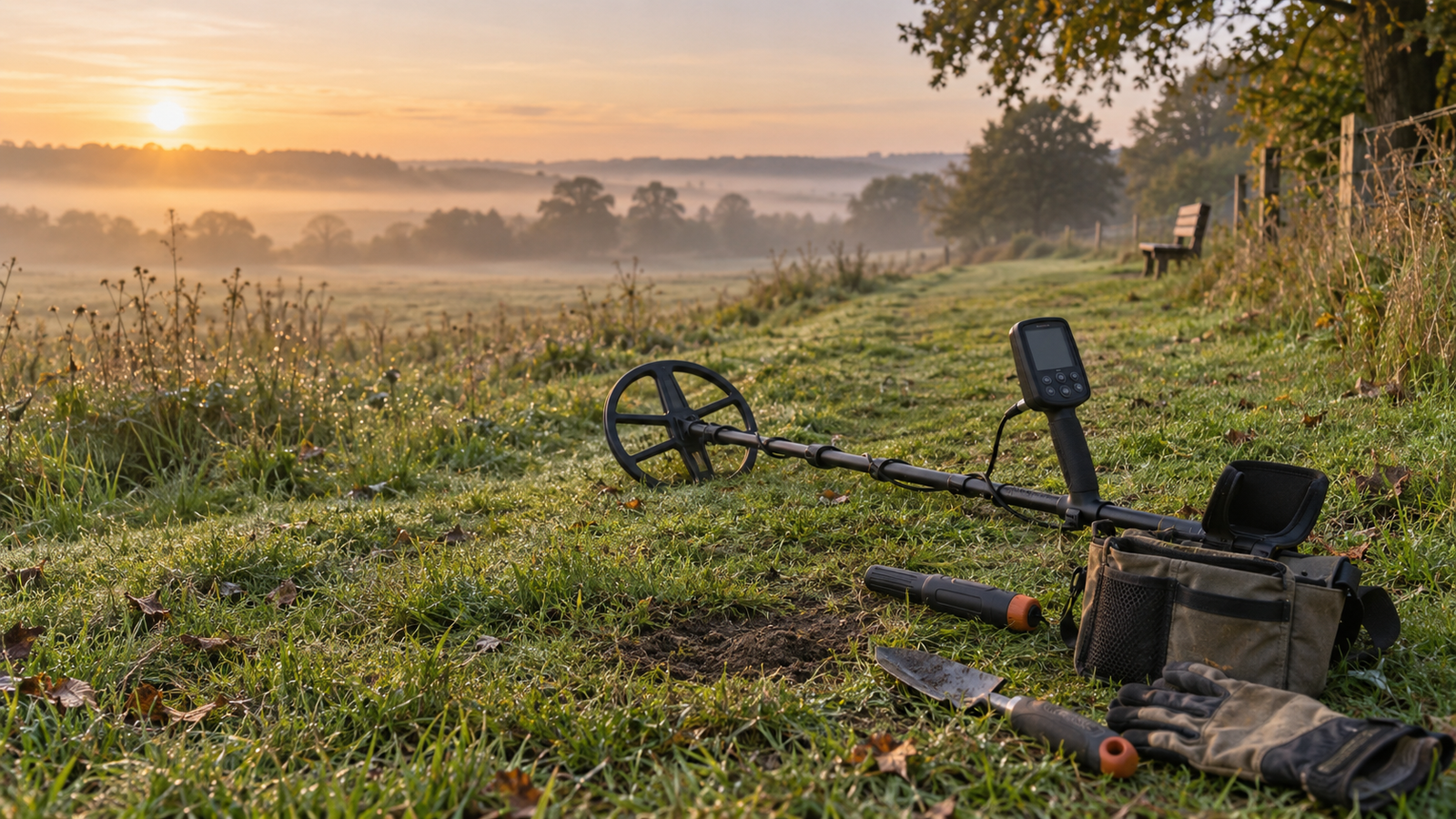
Metal detecting is easiest to learn when you follow a repeatable process: understand your detector, practise on known targets, choose a legal location, and recover every target neatly. This complete beginner guide turns those steps into a simple first-weekend plan.
What You Need to Start Metal Detecting
You do not need the most expensive machine. A beginner-friendly detector with clear controls, adjustable sensitivity, discrimination, pinpoint mode and a numerical Target ID is enough for most parks, fields and dry beaches. Choose a model that feels comfortable in your hand and has a coil suited to the ground you expect to search.
| Essential item | Why it matters | Beginner advice |
|---|---|---|
| Metal detector | Locates conductive objects below the coil | Use a simple general-purpose mode first |
| Headphones | Make faint or short signals easier to hear | Keep volume at a safe level |
| Hand digger | Creates a small, controlled recovery hole | Use a suitable tool for the soil and site rules |
| Finds pouch | Separates finds and removed rubbish | Take every piece of litter home |
| Pinpointer | Locates the target inside the plug or loose soil | Optional, but it greatly speeds recovery |
| Gloves | Protect hands from sharp metal and glass | Never reach blindly into a hole |
Learn the Five Basic Controls
Search mode
Search modes change the detector’s response to groups of targets. Begin with the broad coin, field or all-metal style mode recommended by your manufacturer. Avoid aggressive filtering during your first practice sessions because it can hide useful signals and make learning harder.
Sensitivity
Sensitivity is not simply a depth control. Setting it too high can create false signals from mineralised soil, electrical interference or nearby metal. Begin at a stable middle setting and increase it only while the detector remains quiet and predictable.
Discrimination
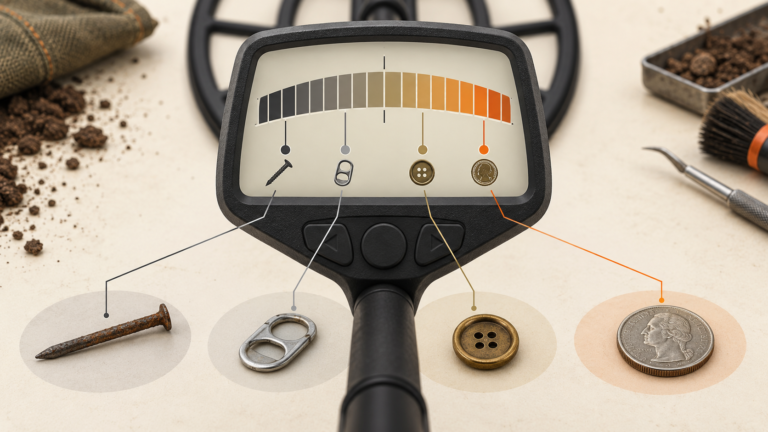
Discrimination helps reject selected target ranges, especially common iron. Use it lightly. Valuable objects can overlap with rubbish on a conductivity scale, so excessive rejection may silence targets worth investigating.
Target ID and tones
A Target ID number represents the detector’s processed estimate of a target’s electrical response. It is a clue, not a laboratory identification. Numbers vary by brand, model, soil, depth, target angle and nearby metal. Listen to the tone and test the signal from more than one direction before deciding to dig.
Pinpoint mode
Pinpoint mode helps centre the target after you have chosen to recover it. Sweep from two directions, mark the strongest point, then use the smallest practical opening. Accurate pinpointing protects the ground and reduces recovery time.
Your 20-Minute Practice Test
Before searching a public or private site, build a small test garden on land where you have permission. Place several objects on clean ground or bury them at shallow, clearly marked depths.
- Test a modern coin, pull tab, bottle cap, iron nail and a small piece of aluminium.
- Sweep each object left to right at a consistent coil height.
- Repeat at ninety degrees and note changes in tone and Target ID.
- Increase the distance between coil and target to hear how a weak signal behaves.
- Place a nail near a coin to experience target masking.
Keep a simple notebook with the object, mode, sensitivity, tone and ID range. This teaches your ears and gives you a model-specific reference that is more useful than a universal number chart.
How to Sweep Correctly
Keep the coil level and close to the surface without striking the ground. Overlap each pass by roughly one third so you do not leave unsearched strips. Walk slowly enough that every tone can be separated. At the end of each swing, resist lifting the coil in an arc—this reduces depth and creates inconsistent coverage.
When a signal repeats, shorten the sweep and cross it from another direction. A stable response from two directions deserves attention. An irregular signal may still be a good target affected by depth, corrosion, angle or nearby iron, so use context rather than one number alone.
Choose a Legal and Productive First Site
Your first hunt should be easy to navigate and legal to search. Private gardens with written owner permission, organised club hunts and explicitly permitted detecting areas are better learning environments than sensitive historic land. Rules can differ by country, municipality, park authority and landowner.
- Confirm who owns or manages the land.
- Ask clearly whether metal detecting and digging are permitted.
- Check restrictions covering archaeology, protected land and reporting finds.
- Agree how significant finds will be handled.
- Avoid utilities, planted areas and unsafe ground.
Use our country guides as a starting point, then verify the current rule with the responsible authority before detecting.
Recover a Target Without Damaging the Site
- Pinpoint the target and estimate its depth.
- Check the surface for glass, wire and hazards.
- Cut the smallest appropriate hinged plug when site rules allow it.
- Place loose soil on a cloth or recovery mat.
- Use a pinpointer to locate the object without widening the hole.
- Return all soil, close the plug and press it level.
- Remove rubbish as well as finds.
If the ground is very dry, recently planted or easily damaged, postpone the recovery or choose another location. The condition you leave behind is part of responsible detecting.
How to Handle Your First Finds
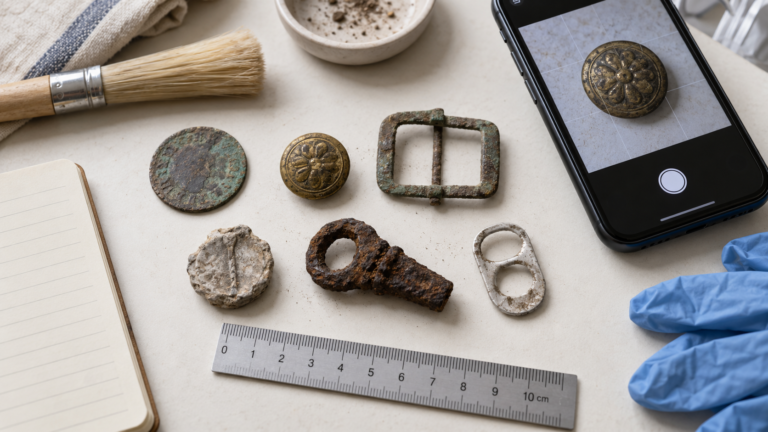
Do not scrub an unknown coin, button or relic in the field. Dry soil can be removed gently, but aggressive cleaning may destroy surfaces, makers’ marks or archaeological evidence. Photograph the object beside a scale, record the location lawfully, and keep separate finds in small bags. Visit our Finds identification hub for a structured identification process.
Seven Beginner Mistakes to Avoid
- Running sensitivity so high that the detector becomes unstable.
- Assuming one Target ID number guarantees a specific object.
- Sweeping too quickly or lifting the coil at each end.
- Rejecting too many target ranges before learning the machine.
- Searching without clear permission.
- Cleaning a potentially valuable object before identification.
- Leaving holes, plugs or recovered rubbish behind.
A Simple First-Weekend Plan
Day one: assemble the detector, read the manufacturer’s quick-start guide, perform an air test and practise pinpointing. Day two: search a small permitted area in a stable general-purpose mode. Dig a representative mix of signals and record what each one becomes. Your goal is not the number of treasures; it is learning the relationship between sound, number, depth and actual target.
Frequently Asked Questions
How much should a beginner spend?
Buy the simplest reputable detector that suits your terrain and budget. Ergonomics, waterproofing needs, local support and understandable controls matter more than a long feature list.
Should beginners dig every signal?
During practice, dig a broad sample. It builds a reliable mental library and shows where desirable objects overlap with rubbish. On later hunts you can make more selective decisions.
Can Target ID tell me exactly what is underground?
No. It estimates a target response. Soil, depth, shape, orientation and adjacent metal can shift the reading. Confirm with tone, repeatability and a cross-sweep.
Where can I compare detector types?
Use the detector guide to compare intended terrain and practical features before buying.
Official Sources and Further Reading
- Minelab: essential tips for getting started
- Garrett: how to read a metal detector
- Garrett: detector troubleshooting
Last reviewed: September 2026. Detector behaviour and local rules vary; consult the current manufacturer manual and responsible local authority.
 Detector Guides
 Identification Guides
 Historic Discoveries