How to Identify Metal Detecting Finds
A professional step-by-step method for photographing, measuring, researching and safely identifying coins, buttons, buckles and unknown metal detecting finds.
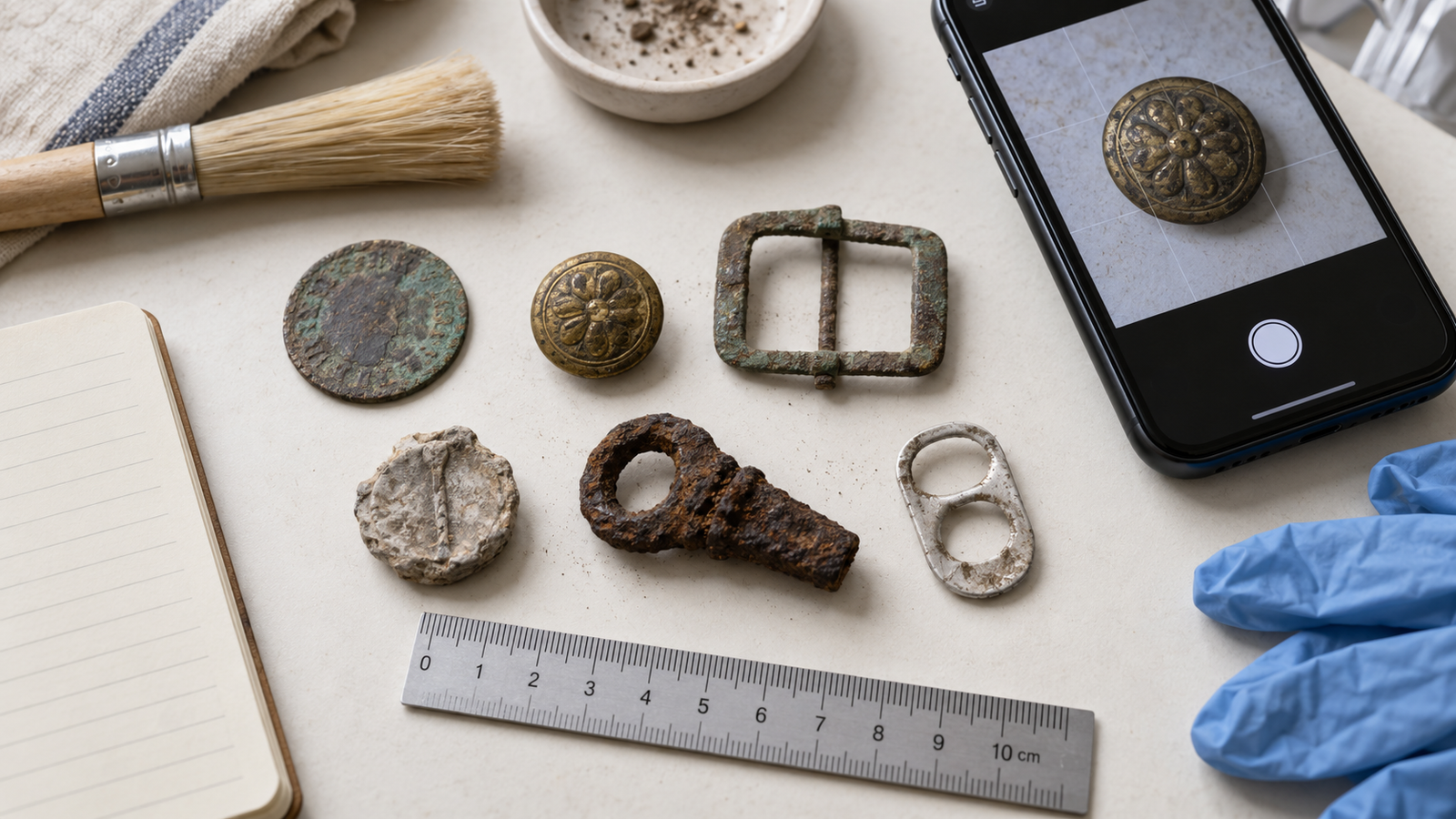
A reliable identification begins before you clean a find. Shape, material, construction, markings and discovery context usually provide stronger evidence than colour alone. This guide gives you a repeatable method for identifying coins, buttons, buckles, tokens and unfamiliar metal objects without destroying useful clues.
Start With Evidence, Not a Guess
Many objects share a similar round, flat or corroded appearance. A confident identification should connect several independent features. Treat the first description as a working hypothesis and keep a record of what supports—or contradicts—it.
The Eight-Step Identification Workflow
1. Stabilise the object
Handle the find gently and keep it dry unless a conservator advises otherwise. Do not bend, scrape or test fragile metal. Separate it from other finds so edges and surfaces are not damaged in storage.
2. Photograph both faces and the edge
Use soft daylight, a plain neutral background and a scale in the same plane as the object. Make one overall photograph, close-ups of marks, a side view and an edge view. Change the light angle to reveal shallow lettering and relief.
3. Record exact measurements
| Observation | How to record it | Why it helps |
|---|---|---|
| Diameter or length | Millimetres with callipers or a clear ruler | Separates similar types and sizes |
| Thickness | Measure an undamaged section | Reveals plate, casting or coin proportions |
| Weight | Grams on a small scale | Supports material and denomination research |
| Fastening | Photograph shank, pin, loop or rivet | Often dates buttons, brooches and fittings |
| Marks | Transcribe exactly; mark uncertain letters | Connects makers, authorities and dates |
4. Describe the construction
Look for a casting seam, stamped sheet, solder joint, drilled hole, machine-cut thread or hand-filed edge. Construction can place an object in a broad technological period even when decoration is missing.
5. Assess the likely material carefully
Colour is unreliable after burial. Note whether a magnet is attracted, but do not use acids, files or destructive scratch tests. Iron commonly develops layered rust; copper alloys may show green corrosion; lead alloys often appear dull grey; aluminium is relatively light. These are clues, not proof.
6. Read symbols and lettering systematically
Rotate the image, use side lighting and make a character-by-character transcription. Search the exact wording in quotation marks, then add object type, approximate dimensions and country. For coins, record portrait direction, legend, date, mint mark and edge style.
7. Use context responsibly
General terrain—beach, garden, pasture or modern park—helps assess probability. Never publish a sensitive archaeological coordinate. Follow local reporting rules and preserve lawful provenance in your private records.
8. Compare with authoritative references
Prefer museum collections, national heritage databases, numismatic catalogues and specialist reference books. Marketplace listings can suggest search terms, but they are not reliable evidence of identity, age or value.
Object-Specific Clues
Coins and tokens
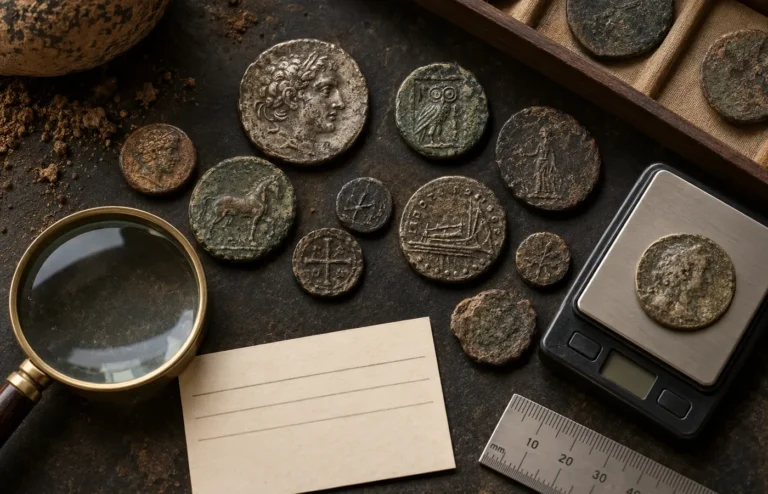
Separate official coinage from trade, transport and advertising tokens. Compare diameter, weight, metal, legends and edge. Wear, corrosion or clipping can change the measured weight, so allow for condition.
Buttons
Record front design, number of holes, shank construction and backmark. The back often carries a maker or city. Military-style symbols require careful comparison because reproductions and civilian designs can be similar.
Buckles and fittings
Frame shape alone is rarely enough. Examine bar position, pin attachment, moulding, plate connection and wear marks. Distinguish clothing buckles from harness, furniture and industrial fittings.
Lead objects
Handle unknown lead with gloves and wash hands afterward. Seals, weights, toys and scrap can resemble one another. Record inscriptions and holes without scraping the soft surface.
Iron relics
Heavy corrosion can make dimensions deceptive. Do not hammer or wire-brush the object. X-radiography by a specialist may reveal the original form when an item is historically significant.
Cleaning: When to Stop
The safest first action is usually no cleaning beyond loose dry soil. Water, oils, electrolysis, acids and abrasive tools can remove original surfaces or trigger later corrosion. If an object may be valuable, archaeological or unstable, consult a qualified conservator. Identification comes before cosmetic improvement.
How to Ask the Community for Help
A useful identification post includes a clear title, both sides of the object, edge and fastening images, measurements, weight, likely material, broad region and any exact lettering. State what you have already compared. Never ask members to identify a small blurred image with no scale.
You can share a well-documented object in the DigTreasures community and browse the Finds hub for category-specific guidance.
Confidence Levels for Your Notes
- Possible: the object shares a general form but key evidence is missing.
- Probable: multiple independent features match a known type.
- Confirmed: diagnostic measurements, marks and construction agree with an authoritative reference.
Keep alternative explanations until diagnostic evidence rules them out. This prevents a popular online guess from becoming a false permanent label.
Frequently Asked Questions
Can an app identify every metal detecting find?
No. Image tools can suggest categories, but corrosion, scale and hidden construction details limit accuracy. Use suggestions as search leads and verify them with references.
Should I clean a coin to reveal the date?
Not before documenting it. Cleaning can remove patina and fine detail. Seek object-specific conservation advice when the surface is unstable or potentially important.
How can I estimate value?
Confirm identity, authenticity and condition first. Then use completed sales, recognised catalogues or a qualified specialist. Asking prices alone do not establish market value.
What if the find may be archaeological?
Stop cleaning and check the current reporting law for the country and region. Protect the discovery context and contact the responsible heritage authority where required.
Next Step
Save this workflow as a field checklist. Once you can describe the evidence clearly, identification becomes faster, safer and much more defensible. For detector-related context, continue to our detector guides.
Last reviewed: September 2026. This guide is educational and does not replace conservation, archaeological or legal advice.
 Identification Guides
 Identification Guides