Metal Detector Target ID Explained
Understand metal detector Target ID numbers, why readings move, how soil and target angle affect them, and how to combine the screen with audio.
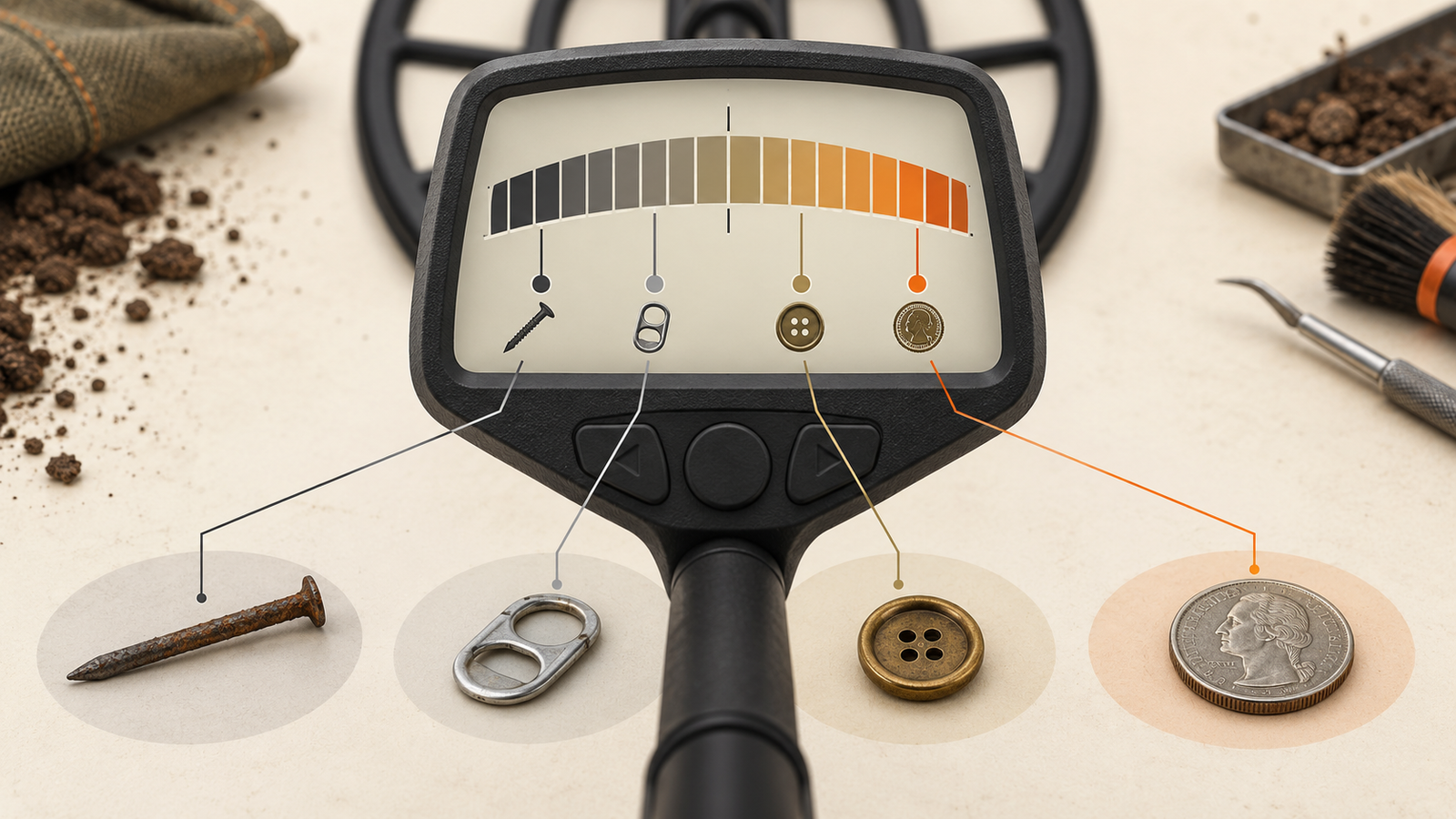
Target ID is a processed estimate of a metal object’s electrical response. It helps you compare signals, but it cannot identify a buried object with certainty. The smartest way to use it is alongside tone, repeatability, depth, ground conditions and a cross-sweep.
What Target ID Actually Measures
When the coil’s electromagnetic field interacts with a conductive object, the detector processes the returned signal and displays a number or segment. Manufacturers commonly organise that response broadly from ferrous to increasingly conductive non-ferrous targets. The displayed value is interpretation by the detector, not a direct reading of an object’s name.
For example, one machine may use a 0–99 scale while another uses negative and positive values. Even when two screens look similar, their numbers are not interchangeable. Use the manual for the exact detector and search mode.
Why the Same Object Can Show Different Numbers
| Factor | Effect on the reading | What to do |
|---|---|---|
| Depth | Weakens and can widen the response | Shorten the sweep and listen for repeatability |
| Orientation | A coin on edge can read differently from a flat coin | Cross-sweep at ninety degrees |
| Soil mineralisation | Adds ground signal and instability | Ground balance and reduce sensitivity if needed |
| Nearby metal | Blends two targets into one response | Use shorter sweeps and change approach angle |
| Corrosion | Changes the effective conductive shape | Treat ID as a range, not an exact point |
| Search mode | Changes processing, tones and rejected segments | Compare only within the same mode |
The Right Way to Check a Signal
- Stop and centre the response with short controlled sweeps.
- Watch the range of numbers, not only the highest value.
- Turn ninety degrees and sweep again.
- Listen for tone shape, clarity and consistency.
- Check the depth indicator and surrounding ground.
- Use pinpoint mode to test whether the response is compact or unusually wide.
- Dig a representative sample and compare the actual object with your notes.
A good target does not have to be perfectly stable, especially when it is deep, tilted or close to iron. Stability is evidence, not a guarantee.
Ferrous and Non-Ferrous Responses
Ferrous targets contain iron and often occupy the lower part of a detector’s scale, but large or irregular iron can produce a high response at the edge of a sweep. This is sometimes called iron falsing. Rotate around the target: a response that disappears, breaks or drops into iron from several angles may be misleading.
Non-ferrous objects include copper, brass, aluminium, lead, silver and gold alloys. Conductivity ranges overlap. Aluminium rubbish can sound similar to jewellery, and thin valuable targets can appear in unexpectedly low ranges. No universal chart can remove that overlap.
Build a Target ID Reference for Your Detector
Create a test set with local coins, ring-shaped aluminium, bottle caps, pull tabs, nails, brass items and a small silver object if available. Keep all tests safe and lawful.
- Select the search mode you use most often.
- Place one object at a time on clean ground.
- Record the tone and ID from two directions.
- Repeat at increasing coil heights.
- Bury selected objects at known shallow depths in a permitted test garden.
- Record the ID as a range rather than a single number.
This personal chart will be more reliable than a chart copied from a different detector, firmware version, coil or soil type.
Target ID Versus Audio
The display is easy to understand, but audio often reacts faster and contains more information. A short clipped tone, smooth rounded tone and long broad response can display a similar number while representing different target shapes or conditions. Experienced detectorists usually combine both channels.
- Repeatable tone: returns at nearly the same centre point.
- One-way tone: needs closer inspection for masking or iron.
- Broad tone: may indicate a large or shallow target.
- Double tone: can occur near an edge or elongated target.
How Sensitivity and Discrimination Affect Decisions
High sensitivity can increase reach but may also amplify interference and ground noise. If Target ID jumps continuously with no target under the coil, lower sensitivity or perform the manufacturer’s noise-cancel and ground-balance procedure.
Discrimination silences selected ranges; it does not remove the physical target. A rejected object can still mask a nearby desirable object. For learning, use modest discrimination and investigate enough ambiguous signals to understand what your site contains.
Common Target ID Mistakes
- Using another brand’s number chart as an exact match.
- Rejecting every jumpy target without cross-sweeping.
- Assuming a high number always means a valuable coin.
- Ignoring tone quality and relying only on the screen.
- Comparing readings taken in different modes.
- Testing indoors near reinforced floors, wiring or electronics.
- Running unstable sensitivity and blaming the target.
A Practical Dig-or-Skip Framework
Ask four questions: Does the signal repeat? Does it centre in the same place? Does it survive a change of direction? Is the response plausible for this site and depth? During a first survey, dig more ambiguous signals to learn the ground. On a littered modern site, become selective only after you have a reliable sample.
For a complete starting process, read Metal Detecting for Beginners. If an unknown object comes out of the ground, use our find identification workflow.
Frequently Asked Questions
What Target ID number is gold?
There is no single gold number. Gold alloy, mass, shape and orientation can overlap with foil, pull tabs and other conductors. Consult the model manual and test representative objects.
Why does my detector show several numbers?
The signal may be weak, affected by soil, adjacent metal, target shape or electromagnetic interference. Cross-sweep, ground balance and use stable sensitivity.
Can a deep coin read as iron?
A weak or masked non-ferrous target can produce mixed responses. Test from several directions and interpret tone, depth and site context together.
Should I notch out pull tabs?
Only with care. Some jewellery and small non-ferrous objects overlap the same range. Learn the site and accept the tradeoff before notching broadly.
Official Sources and Further Reading
- Minelab X-TERRA VOYAGER features and 0–99 Target ID
- Garrett: how to read detector tone, Target ID and depth
- Garrett: checking targets from multiple directions
- Nokta FINDX product and Target ID information
Last reviewed: September 2026. Always use the current manual for your exact detector, coil and software version.
 Detector Guides