How to Photograph a Find for Accurate Identification
Better photos lead to better identifications. Use these simple field photography techniques.
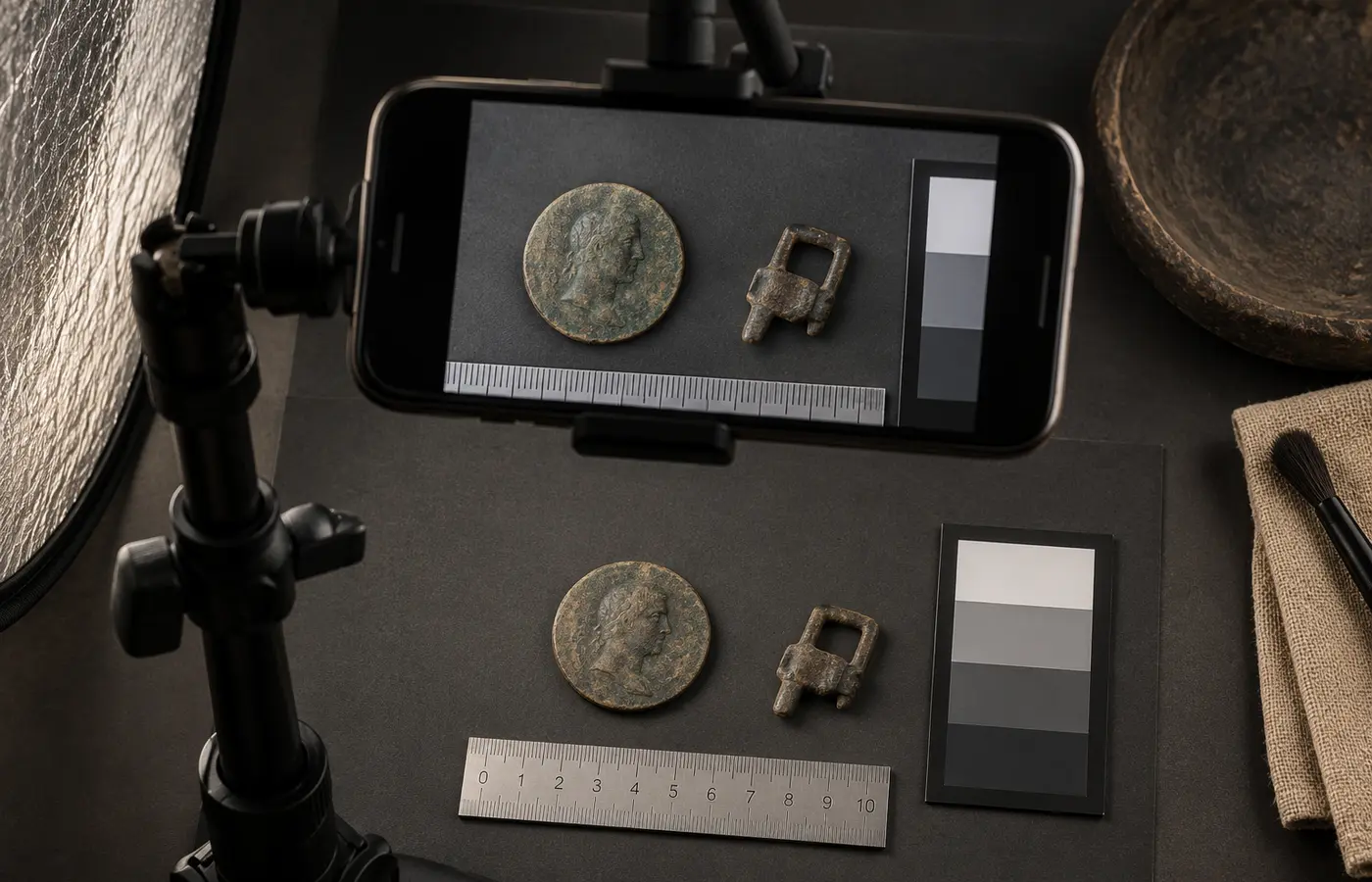
Clear, consistent photographs allow other detectorists and specialists to examine details that are invisible in a dark or blurred phone picture.
Do not clean before the first photographs
Document the find exactly as recovered. If later conservation changes the surface, the original photographs preserve useful evidence.
Use soft, even light
Bright indirect daylight near a window works well. Avoid direct flash, harsh sun and mixed coloured lighting. Move the light to a low angle when you need to reveal shallow lettering.
Choose a plain background
Use neutral grey, white or matte black card depending on the object. Avoid patterned fabric, hands, grass and reflective tables. The camera should focus on the find, not the background.
Take a complete identification set
- Front and back, photographed square to the camera
- Both edges and attachment points
- Close-ups of letters, dates, symbols and breaks
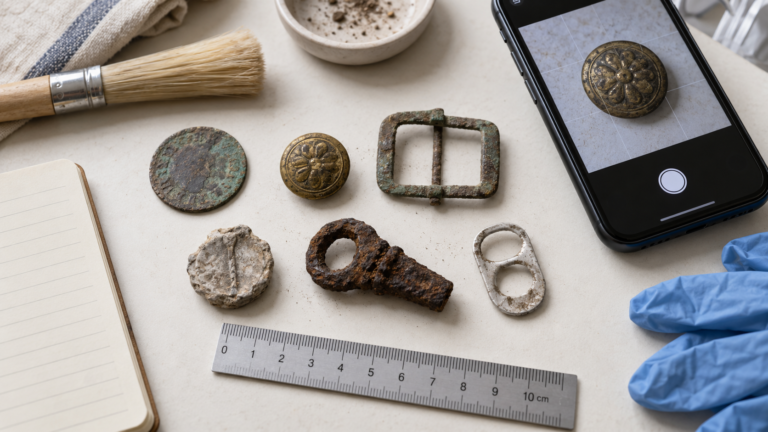
- One image beside a millimetre scale
- One wider image showing the complete object
Keep the camera steady
Rest the phone on a small support, use the timer and tap the object to focus. Move the camera closer instead of relying on digital zoom. Clean the camera lens before shooting.
Preserve accurate colour
Avoid filters, heavy sharpening and dramatic contrast. You may crop and make a small exposure correction, but keep one untouched original file.
Name and organize the files
Use a consistent name such as date-general-region-object-side. Store measurements and notes with the photographs. Remove GPS metadata before sharing images from sensitive locations.
Information to include with the photos
- General country or region
- Dimensions and weight
- Likely material and magnetic response
- Visible characters transcribed carefully
- Detector response as supporting context
Frequently asked questions
Should I photograph a coin in my hand?
A hand can show rough scale, but it should not replace a clear image beside a ruler.
What file should I upload?
Use a sharp JPEG or WebP large enough to inspect fine details without excessive compression.
Continue learning
Use our beginner metal detecting guide, compare equipment in the detector database, and ask for help in the DigTreasures community.
 Identification Guides