The Hoxne Hoard: The Largest Roman Treasure Ever Found in Britain
Introduction
In November 1992, a simple search for a lost hammer changed British archaeology forever.
Near the quiet village of Hoxne in Suffolk, England, a local farmer asked a friend equipped with a metal detector to help recover a missing tool.
The hammer was never found.
Instead, the detector signaled something far more extraordinary.
Buried beneath centuries of farmland lay one of the richest Roman treasure collections ever discovered anywhere in the world.
Today, archaeologists know it as The Hoxne Hoard, the largest and most complete late Roman treasure ever found in Britain.
A Chance Discovery
Unlike many archaeological discoveries made during planned excavations, the Hoxne Hoard was found completely by accident.
Metal detectorist Eric Lawes was searching for a lost hammer when his detector produced several unusually strong signals.
Recognizing that the objects might be historically important, he immediately stopped digging and reported the discovery to local authorities.
This responsible decision allowed professional archaeologists to excavate the site under controlled conditions, preserving invaluable information about the treasure’s original position.
His actions are still considered an excellent example of responsible metal detecting.
Where Was It Found?
The hoard was buried in a rural field near the village of Hoxne, Suffolk, eastern England.
Archaeologists carefully excavated the surrounding area and found the treasure resting inside a large wooden chest that had completely decayed over the centuries.
Although the wood had disappeared, the arrangement of the objects clearly revealed how they had originally been packed.
What’s Inside the Hoard?
The discovery stunned experts.
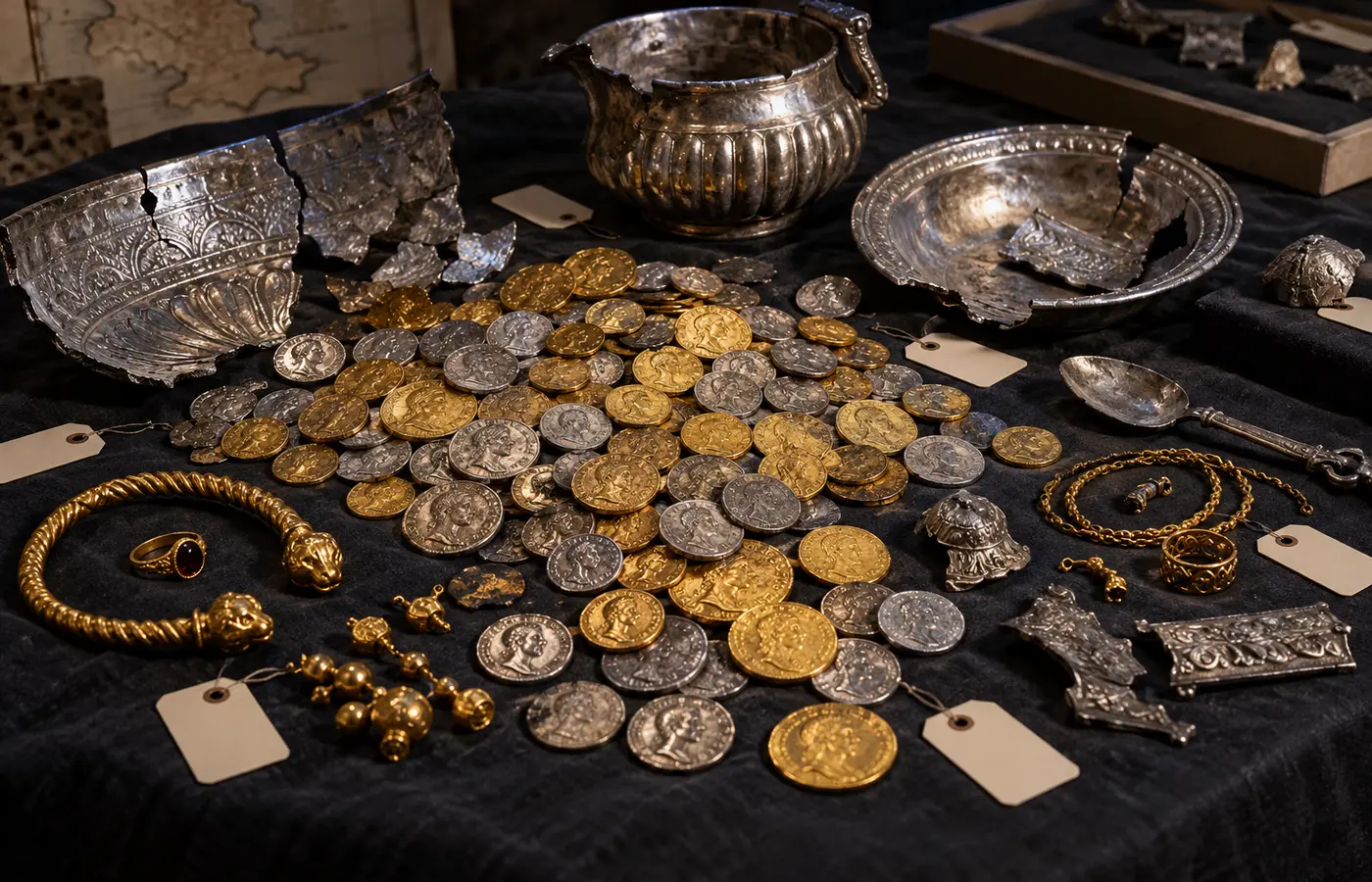
The hoard contained more than 15,000 Roman objects, including:
- Nearly 15,000 Roman gold, silver and bronze coins
- Gold necklaces
- Gold bracelets
- Gold rings
- Silver spoons
- Silver bowls
- Cosmetic tools
- Luxury tableware
- Small decorative boxes
- Personal jewelry
Many pieces remain in remarkable condition despite being buried for more than 1,600 years.
Gold Worth a Fortune
Among the most famous discoveries were several magnificent gold necklaces decorated with emeralds, sapphires and garnets.
One spectacular gold body chain is considered one of the finest examples of Roman jewelry ever discovered.
Its craftsmanship demonstrates the extraordinary wealth enjoyed by elite Roman families during the final years of Roman Britain.
Why Was It Buried?
The treasure dates to approximately AD 407–408, a period of political instability.
At that time, Roman authority in Britain was collapsing.
Historians believe the owner may have hidden the family’s wealth during a time of invasion, civil unrest or military withdrawal, intending to return later.
Sadly, that day never came.
Coins Tell the Story
The thousands of coins inside the hoard helped archaeologists determine its burial date with remarkable precision.
The newest coins were minted during the reign of Emperor Honorius, providing valuable evidence for dating the treasure.
Because coins often include emperors’ names and portraits, they are among the most useful archaeological dating tools.
The Excavation
Professional archaeologists excavated the site using meticulous methods.
Every object was mapped before removal.
Layers of soil were recorded.
Photographs documented the exact position of each artifact.
This careful excavation preserved information that would have been lost if the treasure had simply been dug up.
Conservation
After excavation, conservators spent years cleaning and stabilizing the objects.
Advanced laboratory techniques revealed tiny details invisible in the field.
Many pieces still retain traces of gilding and decorative engraving.
Why the Hoxne Hoard Matters
The Hoxne Hoard is important not only because of its enormous value but because it provides a snapshot of life during the final decades of Roman Britain.
It shows:
- The wealth of Roman households.
- High standards of Roman craftsmanship.
- Trade connections across the Roman Empire.
- The uncertainty surrounding the end of Roman rule in Britain.
Timeline
| Year | Event |
|---|---|
| AD 407–408 | Treasure buried |
| 1992 | Discovery near Hoxne |
| 1992 | Professional excavation |
| 1993 | Conservation begins |
| Today | Displayed at the British Museum |
Interesting Facts
- More than 15,000 objects were recovered.
- It is the largest Roman treasure ever found in Britain.
- The treasure was discovered while searching for a lost hammer.
- The excavation became a model for responsible metal detecting.
- Many objects are made of nearly pure gold.
Frequently Asked Questions
Who found the Hoxne Hoard?
Metal detectorist Eric Lawes discovered it in 1992 while searching for a lost hammer.
How old is the treasure?
Approximately 1,600 years old, dating to the early 5th century AD.
Where is it today?
The Hoxne Hoard is displayed at the British Museum in London.
Why was it buried?
Most historians believe it was hidden during the collapse of Roman Britain and never recovered by its owner.
Conclusion
The Hoxne Hoard remains one of the greatest archaeological discoveries in Europe. More than a collection of gold and silver, it tells the story of a society on the edge of dramatic change. Hidden in hope, forgotten for centuries, and rediscovered by chance, it continues to provide historians with priceless insights into the final years of Roman Britain.
 Historic Discoveries