The Discovery That Changed Anglo-Saxon History
In the summer of 2009, what began as an ordinary metal-detecting outing in the English countryside became one of the most significant archaeological discoveries in modern British history. A local metal detectorist searching a farmer’s field in Staffordshire uncovered a small piece of gold buried beneath the soil.
At first glance, the object seemed insignificant. However, further investigation revealed something extraordinary.
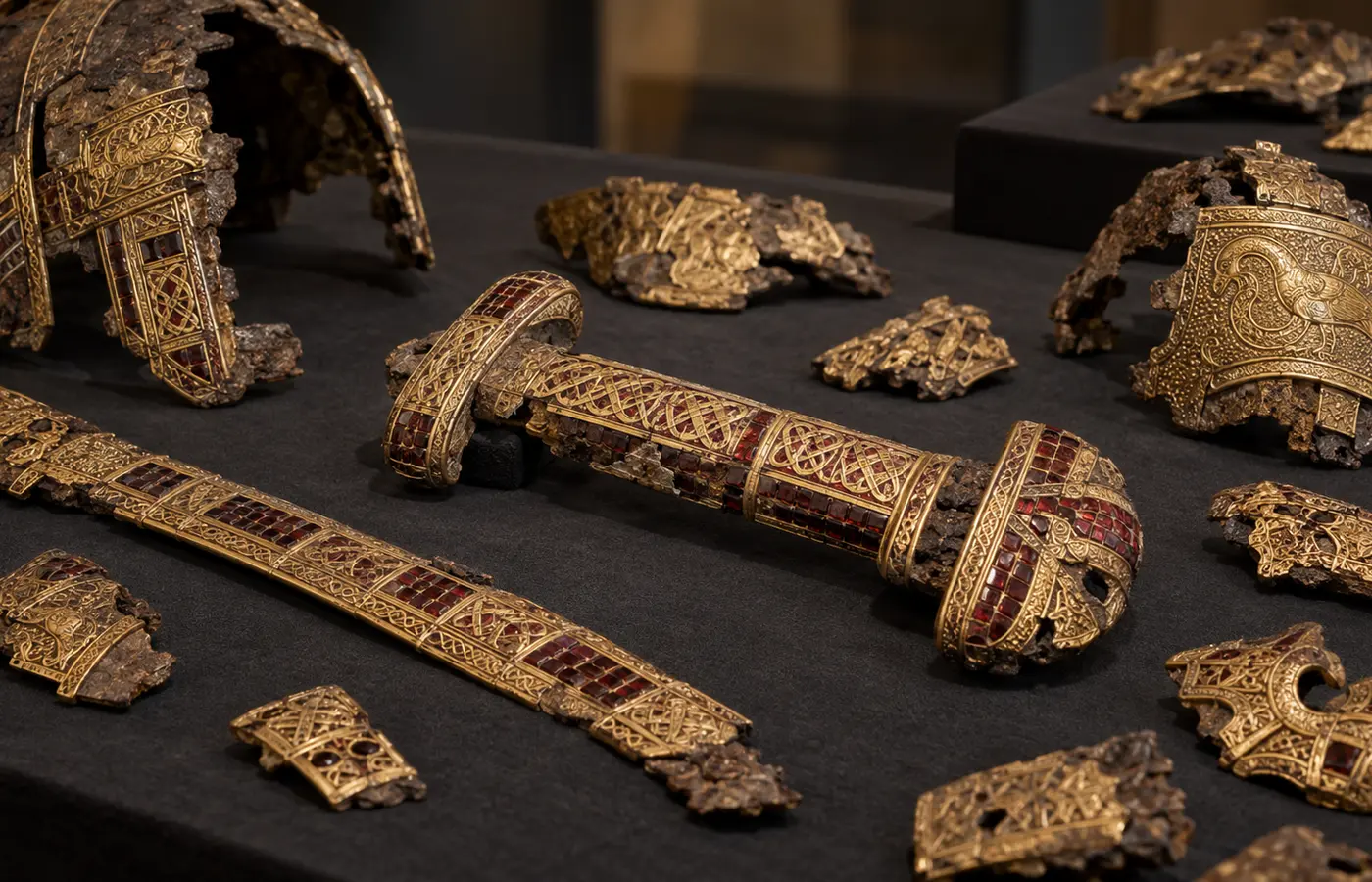
Over the following months, archaeologists uncovered more than 3,500 individual artifacts, many crafted from gold and silver and dating back approximately 1,400 years to the Anglo-Saxon period.
Today, the discovery is known worldwide as The Staffordshire Hoard, the largest collection of Anglo-Saxon gold and silver ever discovered.
Where Was the Hoard Found?
The hoard was discovered near the village of Hammerwich in Staffordshire, England.
The artifacts had been buried in an agricultural field overlooking an ancient route believed to have been used during the early medieval period.
Unlike many treasure discoveries found inside graves or settlements, this collection appeared intentionally buried without any obvious container or structure protecting it.
This mystery immediately fascinated archaeologists.
A Discovery Hidden for More Than 1,300 Years
Experts believe the treasure was buried sometime during the 7th century AD, a period when Anglo-Saxon kingdoms competed for power across Britain.
No written record describes why someone buried such an enormous collection of precious objects.
Several theories have emerged:
- A king hiding war booty.
- Ritual offerings connected with victory.
- Loot collected after major battles.
- A royal armory dismantled during conflict.
Even after years of research, the exact reason remains unknown.
What Was Found?
Excavations recovered an astonishing collection of military and ceremonial objects.
Among them were:
- Sword pommels
- Helmet decorations
- Gold crosses
- Silver fittings
- Jewel-encrusted weapon ornaments
- Decorative mounts
- Religious objects
Interestingly, very few complete weapons were discovered.
Instead, archaeologists found hundreds of decorative components carefully removed from swords and military equipment.
This suggests the collection may have represented trophies stripped from defeated warriors.
Incredible Craftsmanship
Perhaps the most remarkable aspect of the Staffordshire Hoard is its exceptional craftsmanship.
The goldsmiths who created these objects possessed extraordinary technical skill.
Many pieces feature:
- Intricate filigree work
- Garnet inlays
- Cloisonné decoration
- Animal-inspired designs
- Christian symbolism
Some individual components measure only a few millimeters yet contain astonishing detail visible only under magnification.
Their quality rivals the finest surviving metalwork from early medieval Europe.
Gold, Silver and Garnets
Laboratory analysis revealed:
- Approximately 5 kilograms of gold
- Around 1.4 kilograms of silver
- Thousands of carefully cut garnets
The gold purity is exceptionally high, demonstrating access to valuable trade networks extending far beyond Britain.
Researchers continue investigating where these materials originally came from.
A Puzzle Without an Answer
Despite years of study, several mysteries remain.
Why were nearly all the objects related to warfare?
Why were many pieces intentionally damaged before burial?
Why were religious objects mixed with military equipment?
Why has no associated cemetery, fortress or settlement been discovered nearby?
Each new study raises fresh questions rather than providing definitive answers.
The Christian Connection
Several artifacts display unmistakable Christian symbolism.
Beautiful gold crosses were found among the military decorations.
One folded gold cross has attracted particular attention.
Some scholars believe it may have been deliberately bent before burial.
Whether this represented ritual destruction or practical damage remains uncertain.
The discovery illustrates the complex relationship between warfare and Christianity during the Anglo-Saxon period.
Scientific Investigation
The Staffordshire Hoard has been studied using advanced archaeological techniques including:
- X-ray imaging
- CT scanning
- 3D digital reconstruction
- Metallurgical analysis
- Microscopic examination
- Chemical testing
Modern technology continues revealing details impossible to observe during the original excavation.
Researchers still publish new findings more than a decade after its discovery.
Public Display
Today, significant portions of the hoard are displayed in:
- Birmingham Museum & Art Gallery
- Potteries Museum & Art Gallery
The exhibitions attract visitors from around the world and remain among Britain’s most important collections of early medieval archaeology.
Why the Staffordshire Hoard Matters
The discovery transformed historians’ understanding of Anglo-Saxon England.
Before 2009, many scholars believed surviving examples of elite Anglo-Saxon metalwork were relatively rare.
The hoard demonstrated that master craftsmen produced extraordinary quantities of luxurious military equipment.
It also revealed the wealth, artistic sophistication, and political complexity of early medieval Britain.
Timeline
| Year | Event |
|---|---|
| 7th Century | Treasure buried |
| July 2009 | First discovery |
| 2009 | Major excavation begins |
| 2010 | Public exhibitions open |
| Present | Ongoing research continues |
Interesting Facts
- More than 3,500 artifacts were recovered.
- It is the largest Anglo-Saxon treasure ever discovered.
- Most objects relate to weapons rather than jewelry.
- Many pieces were intentionally separated from their original items.
- Research on the collection is still ongoing.
Frequently Asked Questions
Who discovered the Staffordshire Hoard?
It was discovered in July 2009 by a metal detectorist searching a farm field in Staffordshire, England.
How old is the treasure?
Archaeologists date it to the 7th century AD.
Why was it buried?
The exact reason remains unknown. Theories include war booty, ritual deposition, or hidden royal wealth.
Where can it be seen today?
Major parts of the collection are displayed at Birmingham Museum & Art Gallery and The Potteries Museum & Art Gallery.
Conclusion
The Staffordshire Hoard remains one of the greatest archaeological discoveries of the 21st century. Beyond its extraordinary gold and silver, it provides a rare window into the political, religious, and military world of Anglo-Saxon England.
More than fifteen years after its discovery, researchers continue to unlock new secrets hidden within its thousands of artifacts. For historians, archaeologists, and metal detectorists alike, the hoard is a reminder that remarkable discoveries can still lie beneath ordinary fields, waiting to reshape our understanding of the past.
 Historic Discoveries